
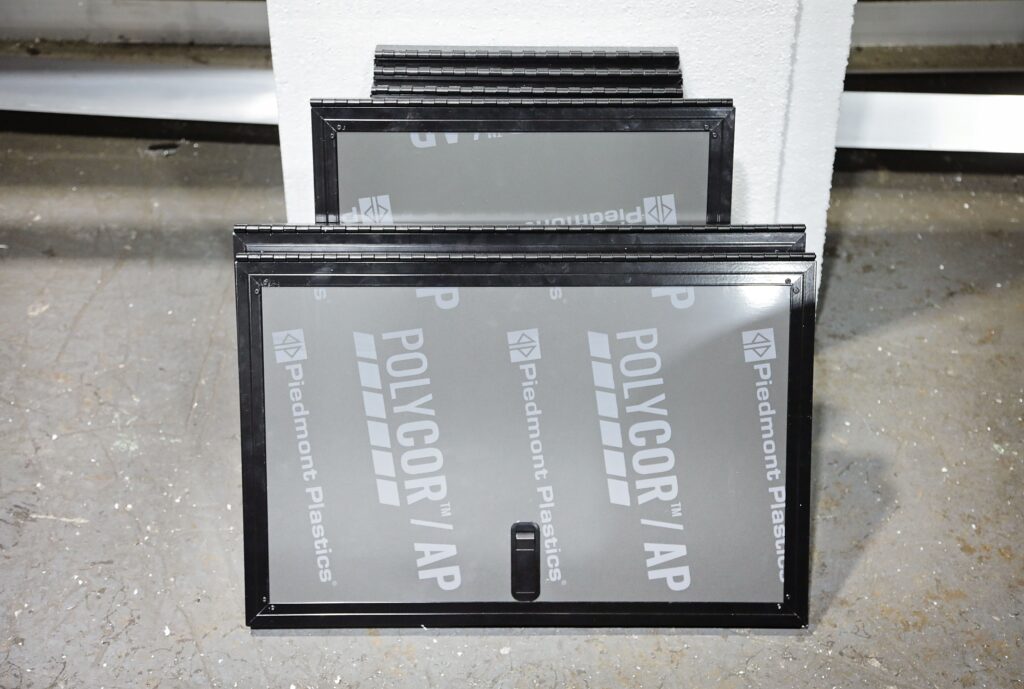
An RV egress window is the emergency exit window that lets you climb out fast when the main door is blocked by fire, a crash, or a jammed latch. It is not a luxury feature. It is a life-safety requirement built into the national standard that governs how recreational vehicles are made, and it is the one window on your rig you never want to discover is painted shut, corroded, or too small to crawl through.
If you build trailers, convert vans, or simply want to replace a failing window in a camper, here is what actually makes a window an egress window, how big it has to be, where the rules apply, and how to order a custom one that fits the opening you already have.
Key Takeaways
- An RV egress window is a designated emergency exit, required as a secondary means of escape under NFPA 1192, the Standard on Recreational Vehicles.
- NFPA 1192 (section 6.2.5.1) sets the minimum opening: it must pass an ellipse 24 inches on its long axis and 17 inches on its short axis (610 mm by 432 mm).
- The difference from a standard window is operation and intent: an egress window opens from the inside by hand, with no key or tool, and is placed in or near sleeping areas.
- U.S. fire departments respond to roughly 4,200 RV fires a year, which is why sleeping quarters should never skip an escape window.
- A cracked, foggy, or undersized egress window is worth replacing with a custom-cut unit that matches your exact opening.
What is an RV egress window?
An RV egress window is a window engineered to double as an emergency exit, sized and hinged so an adult can climb out if the entry door cannot be used. Under NFPA 1192, the Standard on Recreational Vehicles, every RV has to provide a means of escape in addition to its main door, and in the vast majority of towables and motorhomes that secondary exit is a window. The RV Industry Association folds NFPA 1192 into the fire and life-safety criteria behind its certification seal, so a certified rig has already been designed with a compliant escape route.
Mechanically, an egress window is still a window. It lets in light and air like any other. What sets it apart is that it is built and positioned to open fully and quickly from the inside under stress. At SDG Doors & Windows we build these as custom units, which matters because an escape window only works if it actually fits and seals the opening it serves. You can see our full window line on the RV and trailer windows page.
How big does an RV egress window have to be?
The opening has to be large enough for a person to pass through, and the standard is specific about it. NFPA 1192 section 6.2.5.1 requires that a means of escape, if it is not an exterior passage door, provide an opening big enough to let an ellipsoid pass through, generated by an ellipse with a major axis of 24 inches (610 mm) and a minor axis of 17 inches (432 mm). In plain terms, the clear opening must accept a rounded shape that is 24 inches across its long dimension and 17 inches across its short one, with the long side kept horizontal.
That is the clear opening, not the overall frame size, so the glass, screen, and any crank hardware all have to swing out of the way. Placement matters too: the window needs to be reachable, low enough to climb through, and free of permanent obstructions like a bolted-down bed frame or an exterior rack. If you are still mapping out window styles and sizes for a build, our complete trailer window buyer’s guide walks through the broader fit and glass decisions that sit alongside the egress rule.
Why RV egress windows matter: the fire-safety case
The reason the standard is this strict is simple: RVs burn, and they burn fast. According to the U.S. Fire Administration, fire departments responded to an estimated average of 4,200 recreational vehicle fires every year from 2018 through 2020, causing an estimated 15 civilian deaths, 125 civilian injuries, and about $60.3 million in property loss annually. An RV packs a propane system, a fuel tank or generator, wiring, and soft furnishings into a few hundred square feet, and a single blocked doorway can trap everyone inside.
Why the escape window matters
RV fires in the U.S., yearly average
Estimated annual averages for 2018 through 2020.
Source: U.S. Fire Administration.
A working egress window turns a trapped situation into a survivable one. That is why the rule focuses on sleeping areas, where people are least alert and slowest to react. If your camper, toy hauler, or converted trailer has a bed, the space around it is exactly where an escape window earns its place. Replacing a window that no longer opens or seals is not cosmetic maintenance; it restores an exit.
Egress window vs. a standard RV window
The hardware can look similar from the outside, but the two windows are built for different jobs. A standard window exists for light and ventilation. An egress window exists so a person can get out. NFPA 1192 requires the escape opening to be operable from the inside by hand, without a key or a separate tool, and it should be marked and easy to find in low light or smoke. A standard vent window has no such obligation, and many are too small or too high to climb through even when they open fully.
| Feature | Egress window | Standard window |
|---|---|---|
| Primary purpose | Emergency escape | Light and ventilation |
| Minimum opening | 24 in by 17 in clear (NFPA 1192) | No escape minimum |
| Operation | Opens by hand, no tool or key | Crank, slide, or latch |
| Typical location | In or beside sleeping areas | Anywhere |
Both can carry the same glass and screen options. Tinted, clear, or frosted glass, plus tempered and insulated builds for safety and energy efficiency, are all available on either window; you can compare them on our glass and screens page. The egress unit simply has to meet the escape rule on top of whatever glass you choose.
Do you need an egress window in your RV or trailer?
If your rig carries the RVIA certification seal, a compliant means of escape is already baked in. That seal represents a manufacturer’s written pledge to meet more than 500 individual safety-related requirements, checked through more than 2,000 unannounced factory inspections a year covering electrical, plumbing, heating, gas, and fire and life-safety systems. The escape-opening rule is part of that package, so a certified trailer left the line with at least one qualifying exit.
The question gets sharper for custom builds, van conversions, and trailers that started life as cargo haulers. A certification seal may not apply to a one-off build, but the physics of a fire do not care about paperwork. Any enclosed space where people sleep, including food trailers and concession units with a resting berth, needs a real way out that is not the single entry door. In practice that means either a qualifying egress window or a second door. Our custom RV and trailer doors can serve as that second exit where a window will not fit, and our custom glass solutions guide covers how to spec glass for the openings you do have.
Choosing and replacing a custom RV egress window
Demand for safe, road-ready RVs is not slowing down: about 8.1 million U.S. households now own an RV, and the median owner uses it roughly 30 days a year, according to the RV Industry Association’s 2025 Go RVing owner profile. That is a lot of nights spent inside, which makes a cracked, foggy, or stuck egress window worth replacing before the next trip rather than after a close call.
When you order a replacement, start by measuring the rough opening in the wall, not the old window, since a worn frame can be out of square. Confirm the clear opening will still meet the 24-by-17-inch escape minimum once the new frame and screen are in place. Decide on pane count and glass: single-pane for weight and budget, double-pane for insulation and temperature control, with tinted, clear, or frosted options and tempered or insulated glass where safety and energy efficiency matter. Add the screen that fits your use, from standard to high-durability to a custom-fit design.
Because every opening is a little different, we cut each window to fit the specific vehicle rather than forcing a stock size onto it. Our windows and parts are made in-house and shipped nationwide, so a shop in another state can order a unit built for one exact rough opening. If you are marketing a finished unit as American-made, keep in mind the FTC’s Made in USA standard requires an unqualified claim to be “all or virtually all” made in the United States under 16 CFR Part 323, with civil penalties for misuse. When you are ready to spec an egress-size window, contact our team with your opening dimensions and we will build to fit.
Frequently Asked Questions
Is an egress window required in every RV?
Every RV built to NFPA 1192 must provide a means of escape in addition to the main entry door, and in most rigs that escape is a window. RVs carrying the RVIA certification seal are built to meet that rule. Custom builds and conversions are not automatically certified, but the same escape logic should be applied to any space where people sleep.
What size does an RV egress window need to be?
NFPA 1192 section 6.2.5.1 requires the clear escape opening to pass an ellipse measuring 24 inches on its long axis and 17 inches on its short axis (610 mm by 432 mm). The glass, screen, and hardware all have to clear that opening, so the overall frame is larger than the minimum.
Can I turn a standard RV window into an egress window?
Only if the clear opening meets the escape minimum, the window opens from the inside by hand without a tool or key, and it sits where an adult can actually climb out. If the opening is too small or too high, you need a larger window or a second door rather than a relabeled vent window.
Does SDG make custom egress-size windows?
Yes. We custom-cut RV and trailer windows to a specific rough opening, in single or double pane with tinted, clear, frosted, tempered, or insulated glass and a screen to match. Send us your measurements and we will build and ship a unit sized for your exit.
Getting the exit right is the cheapest insurance on the whole rig. Measure the opening, hold the new window to the 24-by-17-inch rule, and order a unit built to fit rather than one you have to fight into place.