
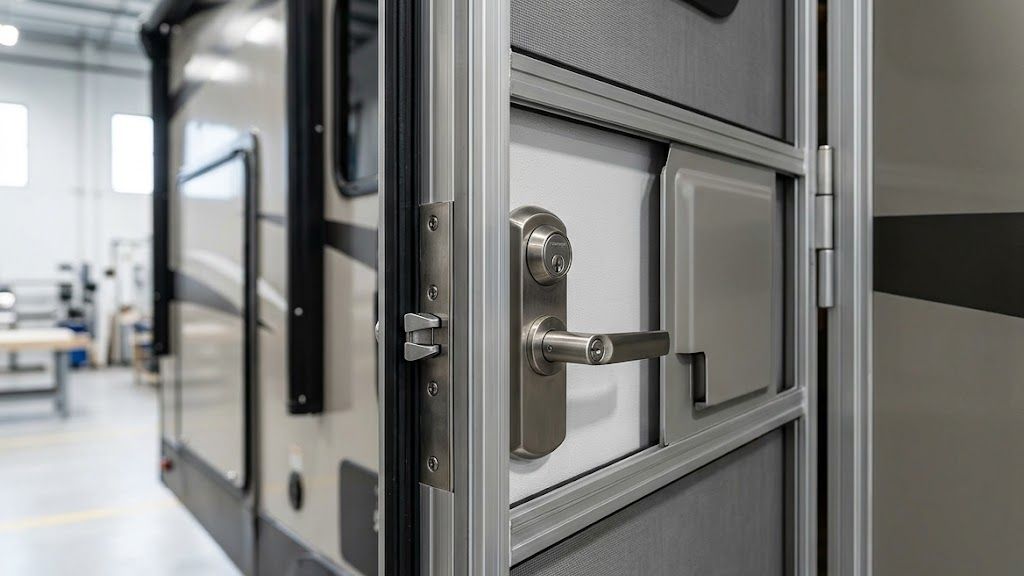
An RV door screen is the mesh panel: the screen and the frame that holds it. An RV screen door is the complete secondary door that panel sits in. Searchers use the two phrases for each other, but they are two different orders. One is a panel that goes back into a frame you already have. The other is a door built to an opening. This page covers both — which one your rig needs, what to measure before you order, and which mesh and glass SDG Doors & Windows builds.
Key Takeaways
- An RV door screen is the mesh and its frame. An RV screen door is the whole door. SDG supplies replacement screen frames and mesh, and builds complete screen doors.
- RV and trailer entry openings are rarely residential sizes, so the frame opening gets measured before anything is ordered. SDG publishes no size chart, and the measurements are the order.
- Mesh grade is the decision that lasts: standard screens for everyday use, high-durability screens for heavy-duty and commercial use, custom-fit designs matched to your dimensions.
- Tinted, frosted, clear, tempered, or insulated glass can pair with a screen door for privacy, UV control, and temperature comfort.
- SDG builds the doors, screens, and glass in-house and ships nationwide from Waycross, Georgia.
RV door screen or RV screen door: which one you need
Check the frame before you check the mesh. If the screen door hangs square, latches, and seals at the edges, and the only problem is a tear, a sag, or a hole, you need an RV door screen — a new mesh panel in that frame. If the frame is bent, corroded, missing, or was never the right size for the opening, you need an RV screen door, built to the opening. Replacing mesh inside a frame that no longer sits flat puts new screen behind the same gap.
| What you order | What it is | Order it when |
|---|---|---|
| RV door screen | The insect mesh and the frame that holds it, fitted into a screen door or entry door you already have | The door hangs square and seals, and only the mesh has failed |
| RV screen door | The complete mesh-fitted secondary door that hangs at the entry, in front of or built into the solid door | There is no screen door on the rig, or the existing frame is bent, corroded, or the wrong size for the opening |
The same split runs through what SDG stocks and what it builds. Replacement screen frames and mesh are stocked and supplied through parts and accessories. Complete doors and the screens that go in them are built to your dimensions — see custom trailer screens and custom RV and trailer doors.
Types of RV screen door, and the door screens that go in them
There are four common ways to put a screen at an RV entry. Each one trades convenience, durability, and cost differently. The right pick depends on how often you travel, how rough the environment is, and whether you want a permanent fixture or something you can take off.
| Screen type | Best for | Trade-off |
|---|---|---|
| Built-in slide or retractable screen | Daily use, clean look | Higher cost, moving parts to maintain |
| Hinged screen door over the main door | Full-time and heavy use | Adds weight and depth at the entry |
| Magnetic screen curtain | Budget setups, quick add-on | Least durable, poor wind resistance |
| Full custom screen-door replacement | Odd-size openings, food and cargo trailers | Needs accurate measurements up front |
The first three take a mesh panel you can change without touching the door. The fourth is the case where the opening decides: if the sidewall curves, or the frame was cut to a size no stock door matches, a door built to the opening is the only version that seals. That is the condition most screen doors for RVs older than a few model years arrive in.
Mesh and glass: what SDG builds, and what it stocks
Mesh grade is the choice that decides how long the screen lasts. SDG builds three screen options, and they are described plainly on the custom trailer screens page:
- Standard screens for everyday use — the weekend and seasonal camper.
- High-durability screens for heavy-duty applications — pets, brush, full-time living, and commercial rigs that get slammed a hundred times a shift.
- Custom-fit designs matched to your specific dimensions, for openings that no stock panel covers.
Heavier mesh resists dogs, brush, and repeated slamming better than lightweight window screen. That is why full-time and commercial owners size up, and why a torn screen in a busy rig is usually a mesh-grade problem rather than bad luck.
Glass is the other half of the entry. Each piece is custom-cut, and the finishes do different jobs: tinted glass for privacy and UV protection, frosted glass for discretion, clear panels for daylight and visibility, and tempered or insulated glass for safety and energy efficiency. A door can carry a glass panel and a screen at the same time — the glass for travel and cold nights, the screen for warm days. The same glass options apply to custom RV and trailer windows if the rig needs new panes as well.
Hardware is the part SDG stocks rather than builds. Locks, handles, hinges, and latches, along with replacement screen frames and mesh, are supplied from parts and accessories. If a latch is the only thing wrong, our guide to trailer door latches and locks covers that choice on its own.
How to measure an RV door opening for a screen
When you are specifying a screen door for an RV or a trailer, measure the frame opening first, because these doors are rarely built to standard residential sizes. Measure the height and the width in several places rather than once: a frame that has flexed on the road will not be the same width at the top and the bottom. Note which side the hinges sit on. Check whether the sidewall has any curve that a flat screen frame would fight against. A quarter inch of error at the top leaves a gap, and a gap is the whole of what a screen is supposed to stop.
Have these five things written down before you ask for a quote:
- Frame opening height and width, taken at the top, middle, and bottom.
- Hinge side, seen from outside the rig.
- Whether the sidewall is flat or curved at the opening.
- Whether you are ordering a mesh panel for an existing frame or a complete screen door.
- Mesh grade, and any glass panel and finish you want alongside it.
SDG works through your dimensions and then builds the door to them, so the finished door fits the opening instead of being shimmed or trimmed to fit. There is no published size chart to order from and no part number to match — the measurements are the order. Send them to our team, or read the sizing notes on the RV door buying guide first if you are specifying the solid door at the same time.
Why fit an RV door screen at all
Ventilation has a direct effect on air quality inside a small, sealed cabin. Americans spend roughly 90 percent of their time indoors, and concentrations of some pollutants indoors are often 2 to 5 times higher than typical outdoor levels, according to the U.S. Environmental Protection Agency. An RV concentrates that into a few hundred square feet.
Cooking, propane appliances, damp gear, and body heat build up fast in a closed rig. Opening the solid door behind a screen flushes out humidity and cooking odors, and cuts the condensation that leads to mold, mildew, and soft spots in the floor and walls. It also reduces how often you run the air conditioner on a day when a cross breeze would do the job. There are 8.1 million American households owning an RV, according to the RV Industry Association, and the median owner age has fallen from 53 in 2021 to 49 in 2025 — newer owners camp in warmer months and expect a rig that stays comfortable without constant air conditioning.
The case for airflow
Why RV owners fit a door screen
A growing, younger ownership base and the air-quality case for ventilation.
RV Industry Association ownership and owner-age data; US Environmental Protection Agency indoor air quality findings.
Do RV screen doors actually keep bugs out?
Yes, as long as the mesh is intact and the frame seals against the opening. The EPA advises making sure window and door screens are in good working order as a basic barrier against mosquitoes and other biting insects. A screen is a physical wall. Mosquitoes, flies, gnats, and wasps cannot pass through correctly sized mesh — but one tear, or one gap at the edge, undoes all of it.
That is why the two decisions on this page are the same decision. Mesh grade determines how long the screen stays intact; fit determines whether there is a gap for insects to walk around it. SDG screens are made to resist tears and wear, and the grade is yours to pick. If you camp near water, in wooded areas, or through peak insect season, the heavier mesh pays for itself the first evening a swarm arrives.
Fitting a screen door and keeping the mesh sound
Most RV screen doors bolt to the existing door frame and go on with basic hand tools in an afternoon. The sequence is to dry-fit the frame, mark the mounting holes, seal the perimeter against water and air, fasten the frame, then hang and adjust the screen so it closes flush. Take the time over the seal: a tidy gasket line is what stops both insects and drafts. Step-by-step install guides for concession and cargo doors sit alongside sizing help on the frequently asked questions page.
Maintenance is light and not optional. Wash the mesh with mild soap and water. Check the seal and the hinges a few times a season. Patch small tears before they spread, and replace a worn latch or a torn panel early instead of living with the gap — that is the point at which a door screen order is cheaper than a screen door order.
Screens on commercial and food-trailer doors
On a commercial rig the same logic stops being a comfort choice. Food codes generally require operators to keep insects and pests out of areas where food is prepared and served, which puts durable screens on doors into the compliance conversation rather than the comfort one. A hot kitchen on wheels also needs real airflow, so ventilation and pest control have to work together instead of against each other.
SDG builds doors, screens, and glass for RVs, cargo trailers, and food trailers, so an operator can order a screen door and the matching glass for the same build. High-durability mesh, tempered or insulated glass, and custom dimensions all carry more weight here than on a weekend camper, because a commercial rig runs longer hours in harder conditions. For the service-window side of the same build, see food trailer windows.
Frequently Asked Questions
What is the difference between an RV door screen and an RV screen door?
An RV door screen is the mesh panel and its frame. An RV screen door is the complete secondary door the panel is fitted into. If the door still hangs square and seals, you need the panel. If the frame is bent, corroded, or the wrong size, you need the door.
Do I need a whole new screen door, or just new mesh?
Close the door and look at the edges. Even contact all the way around, and a latch that catches without lifting the door, means the frame is sound and a new mesh panel will fix it. Daylight at a corner, or a frame that has to be pulled to latch, means the door itself is the problem.
Can I add a screen door to any RV or trailer?
In most cases, yes. Because openings vary so widely, a custom-fit or custom-built screen door is the most reliable way to get a clean seal on an older or nonstandard rig. Measuring the exact opening first is the step that decides it.
What is the difference between a screen door and a solid RV door?
A solid door provides security, insulation, and weather protection. A screen door provides airflow and insect protection. Many owners use both: the solid door for travel and cold nights, the screen door for warm days when they want a breeze without the bugs.
How do I stop my RV screen door from tearing?
Choose a higher-durability mesh if you have pets or camp in rough conditions, keep the screen clean, and repair punctures right away. Standard window-weight mesh tears faster than the heavier screens built for full-time and commercial use.
Do RV screen doors help with heat?
Yes. Opening the solid door behind a screen lets hot, humid air out and pulls a cross breeze through the cabin, which can cut how often you run the air conditioner on mild days. It will not replace air conditioning in extreme heat, but it makes a real difference in shoulder-season weather.
Does SDG ship RV screen doors nationwide?
Yes. SDG Doors & Windows builds custom doors, screens, and windows and ships them nationwide from Waycross, Georgia, so owners anywhere in the country can order a screen door built to their own opening.
Order an RV door screen or a screen door from SDG
SDG Doors & Windows builds custom RV, trailer, and food-trailer doors, screens, and windows in-house, then ships them nationwide. The company is part of the Southern Dimensions Group family, which has been building trailers since 2001, so the team knows how these openings are framed and what makes a screen door seal and last. Send your opening measurements and mesh grade to our team and we will work through the screen, glass, and hardware for the way you travel. If you are replacing the solid door at the same time, start with custom RV and trailer doors.