
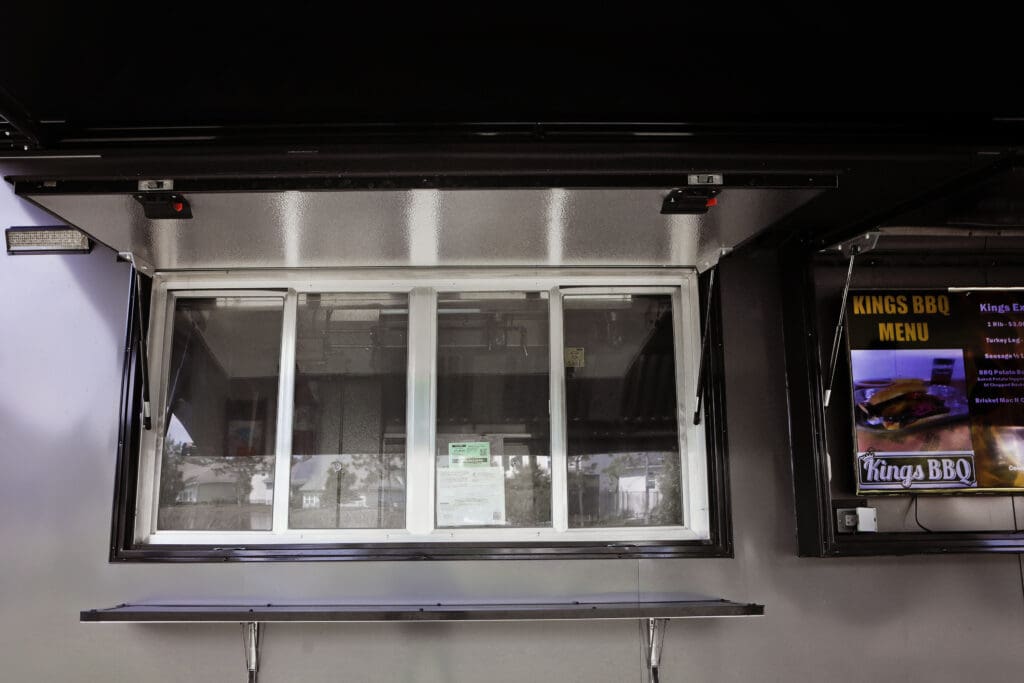
The short answer: the right trailer window is defined by four measurements and one decision. The four measurements are rough opening width, rough opening height, sidewall thickness, and corner radius. The decision is single pane or double pane. Nail those five things and the rest, tint level, screen type, slider or awning style, turns into preference instead of a fitment problem.
Most people do not shop for a trailer window until something forces them to. A rock takes out the glass. A seal fails and the wall behind it goes soft. An inspector flags the serving opening on a food trailer. At that point the goal is not a lesson in glazing, it is a part that fits the hole in the wall and stops the water. This guide is written for that moment.
Key Takeaways
- Federal glazing rules (FMVSS No. 205) cover motorhomes, slide-in campers, and pickup covers, but towable trailers are not on the list, so glass quality depends on the manufacturer you buy from.
- Suppliers need five specs to build a correct window: rough opening width and height, sidewall thickness, corner radius, and pane type.
- Double pane cuts heat transfer and condensation. Single pane is lighter and cheaper. Climate and use decide, not price alone.
- Concession and food trailer openings carry a rule house windows never see: screens at least 16 mesh to the inch when the window stays open for ventilation.
- Nearly every leak starts at the seal or the flange, not the glass, which is why the wall thickness measurement matters more than most buyers expect.
Do trailer windows have to meet a federal safety standard?
Motorhomes do. Most towable trailers do not. Federal Motor Vehicle Safety Standard No. 205 applies to “passenger cars, multipurpose passenger vehicles, trucks designed to carry at least one person, buses, motorcycles, slide-in campers, pickup covers designed to carry persons while in motion and low speed vehicles,” and it requires glazing to conform to ANSI/SAE Z26.1-1996 (49 CFR 571.205). Travel trailers, cargo trailers, and concession trailers are not named in that application list.
That gap is the single most useful thing a buyer can understand. When no federal glazing rule reaches your trailer, the quality of the glass, the frame extrusion, and the seal is set entirely by whoever built the window. Two windows can look identical in a photo and behave nothing alike after eighteen months of highway vibration.
The recreational vehicle industry fills part of that gap voluntarily. NFPA 1192, the standard on recreational vehicles, took effect January 1, 2021 with a mandatory enforcement date of July 1, 2021 (RV Industry Association). If your unit is a certified RV, it was built to that standard. If it is a cargo or concession trailer, your protection is the reputation of your supplier.
What makes a trailer window different from a house window?
Why towable-specific glazing and screens matter
Source: RV Industry Association 2025; FDA Food Code.
A trailer window has to clamp to a wall that is often one to two inches thick, not six, and it has to do that while the whole structure flexes down the interstate. House windows sit in a static, plumb, square opening. Trailer walls are a sandwich of skin, framing, and insulation that moves, and openings are rarely perfectly square after a few seasons.
That difference drives the entire design. Trailer windows use a clamp ring or a screw flange that sandwiches the wall between an exterior frame and an interior trim ring. The wall thickness you measure is what determines whether that sandwich closes correctly. Too thin and the clamp never tightens. Too thick and the ring will not seat.
Corner radius matters for the same reason. Trailer openings are usually cut with rounded corners to prevent stress cracks in the skin, and a window built for a 3 inch radius will not sit flat in an opening cut at 4 inches. At SDG Doors & Windows, every unit is built to order for exactly this reason: the opening in your wall is the specification, not a catalog number.
How do you measure a trailer window for replacement?
Measure the rough opening, not the old window. In 2025 the RV industry shipped 342,220 units, and 306,191 of those were towables (RV Industry Association). Those units come from dozens of builders across hundreds of floor plans, so there is no universal size chart to fall back on. Your wall is the only reliable source of truth.
Take these five specs before you call anyone:
| Spec | How to take it | Why it matters |
|---|---|---|
| Rough opening width | Inside edge to inside edge of the cut hole, at top, middle, and bottom | Out of square openings need the smallest measurement |
| Rough opening height | Inside edge to inside edge, at left, center, and right | Same reason, take three readings |
| Sidewall thickness | Depth from exterior skin to interior wall surface | Sets the clamp ring or flange depth |
| Corner radius | Trace a corner on paper or match against a known round object | A mismatched radius will not seat flat |
| Pane type | Count the layers of glass at the edge | Determines frame depth and weight |
Two habits save the most rework. First, measure in three places on each axis and give your supplier the smallest number, because openings are seldom square. Second, photograph the corner and the wall edge with a tape in frame. A photo resolves ambiguity faster than any description over the phone.
Single pane or double pane trailer windows?
Choose double pane when the trailer is occupied, heated, or cooled. Choose single pane when it is a cargo box, a rarely used utility unit, or weight is the priority. The energy case is well documented in housing: replacing single pane windows with certified units lowers household energy bills by an average of up to 13 percent nationwide, and even a standard double pane window still admits roughly 75 percent of the sun’s heat (ENERGY STAR).
Trailers amplify both effects. The interior volume is tiny, the wall insulation is thin, and the glass to floor area ratio is high, so a window is a much larger share of your thermal envelope than it would be in a house. That is also why tint is not cosmetic on a trailer. It is climate control.
| Single pane | Double pane | |
|---|---|---|
| Best for | Cargo trailers, utility units, weight sensitive builds | Living quarters, food trailers, four season use |
| Insulation | Minimal | Insulating air gap between panes |
| Condensation | Common in cold weather | Sharply reduced |
| Weight | Lighter | Heavier |
| Cost | Lower up front | Higher up front, lower operating cost |
Pane choice also changes the sound inside the unit. If your trailer doubles as a workspace, a sleeping space, or a service window for customers, the second pane earns its cost in quiet before it ever earns it in energy. Our breakdown of trailer window pane types walks through the comfort tradeoffs in more depth.
What glass, tint, and screen options actually matter?
Three choices carry real weight: glass type, tint level, and screen quality. Everything else is trim. Since ANSI/SAE Z26.1 is the glazing standard referenced by federal rule for covered vehicles (49 CFR 571.205), asking a supplier which safety glazing they use is a fair and fast quality test, even on a trailer that the rule does not reach.
Tint is the choice buyers most often get wrong in both directions. Heavy tint on a cargo trailer that needs interior visibility makes loading miserable. Clear glass on a food trailer parked in full sun in July turns the service area into an oven. Match the tint to how the space is used, not to how the trailer looks in a parking lot.
Screens are the quietly critical part. A screen that sags, tears, or pops out of its channel is the difference between an open window and a closed one on a hot day. We build glass and screens as made to order components precisely because the frame, the mesh, and the channel have to match the window they serve.
What is different about concession and food trailer windows?
Concession windows carry a health code requirement that no residential window ever sees. Under the FDA Food Code, when windows are kept open for ventilation or other purposes, the openings must be protected against insects and rodents by “16 mesh to 25.4 mm (16 mesh to 1 inch) screens,” air curtains, or other effective means (FDA Food Code 2022, section 6-202.15). Most states adopt some version of the Food Code, so this is the rule your local inspector is likely working from.
Practically, that means three things when you spec a serving window:
- The screen is regulated equipment, not an accessory. Confirm the mesh count before you order, not after an inspection.
- The opening has to close tight when it is not in service. Tight fitting windows are the baseline requirement, with screening as the alternative when the window stays open.
- The awning or lift geometry has to clear your counter. A serving window that fouls the counter or the awning arm is a daily annoyance for the life of the trailer.
Concession openings are also usually larger than living quarters windows, which puts more load on the frame and the seal. That is one more reason serving windows are worth building to the actual opening rather than trimming a wall to fit a stock unit.
Why do trailer windows leak, and how do you prevent it?
Leaks start at the seal and the flange, almost never at the glass itself. Glazing standards like ANSI/SAE Z26.1 certify impact resistance and optical clarity, not the water tightness of the installation around the pane. A perfect piece of glass in a poorly clamped frame will still let water into your wall.
Four causes account for most failures we see:
- Wall thickness mismatch. The clamp ring never fully compresses the butyl tape, so the seal is loose from day one.
- Butyl tape reused or skipped. Old tape hardens. It will not re-seal, and it is the cheapest part of the entire job.
- Overtightened screws. Crushing the frame distorts it and opens gaps at the corners.
- Sealant used as a substitute for fit. Exterior sealant is a secondary defense. It cannot rescue a window that does not fit the opening.
The prevention is unglamorous and effective. Fit the window to the measured opening, use fresh butyl tape, tighten in a cross pattern to snug rather than crushed, and inspect the perimeter twice a year. Catching a soft spot early is the difference between a tube of sealant and a wall rebuild.
Custom or off the shelf: when does custom pay off?
Custom pays off whenever the opening is nonstandard, the wall is an unusual thickness, or the window has to do a job a catalog unit was not built for. The towable market shipped 342,220 units in 2025 with a retail value of $20.40 billion (RV Industry Association), and that volume is spread across an enormous range of build specs. Stock sizing works when you happen to land on a common one. It fails everywhere else.
The honest tradeoff is lead time. A made to order window takes longer than pulling a boxed unit off a shelf. What you get back is a window that fits the hole you actually have, in the pane type, tint, and screen configuration your use case calls for, without cutting or patching your sidewall to make a stock part work.
SDG Doors & Windows has been part of the Southern Dimensions Group family of companies since 2001, alongside SDG Trailers and SDG Cargo Trailers. Everything is built in house at our Waycross, Georgia facility and shipped nationwide to dealers, repair shops, and owners replacing a single window. Building trailers and trailer parts under the same roof is why we ask for the opening measurement first and the catalog number never. You can read more about our team and process or browse trailer and RV doors if the project involves more than glass.
How to order a replacement trailer window
- Measure the rough opening at three points on each axis and record the smallest reading.
- Measure the sidewall thickness from exterior skin to interior finished surface.
- Identify the corner radius and photograph a corner with a tape measure in frame.
- Decide pane type and tint based on how the space is used year round.
- Confirm screen requirements, including mesh count if the trailer serves food.
- Send the specs and photos to a builder who works to your numbers.
Have those six items in hand and a quote takes minutes instead of a week of back and forth. Call (912) 288-1041 or use our contact form and our team will walk through the specs with you.
Frequently Asked Questions
What size are standard trailer windows?
There is no single standard size. Trailer windows are sized to the rough opening cut into the sidewall, and openings vary by manufacturer, model year, and floor plan. Measure your opening rather than searching for a size that matches your trailer brand.
Can I replace a single pane trailer window with a double pane?
Usually yes, as long as the frame depth suits your sidewall thickness and the wall can carry the added weight. Give your supplier the sidewall thickness measurement so the clamp ring depth is correct for the heavier unit.
Do trailer windows need safety glass?
Vehicles covered by FMVSS No. 205, including motorhomes and slide-in campers, must use glazing conforming to ANSI/SAE Z26.1-1996. Towable trailers are outside that application list, but safety glazing remains the sensible choice for any occupied space.
What screen do I need for a concession window?
At minimum 16 mesh to 1 inch, per the FDA Food Code, whenever the serving window is kept open for ventilation. Check your state and county adoption of the Food Code, since local requirements can be stricter.
How do I stop my trailer window from leaking?
Reseat the window with fresh butyl tape, confirm the frame matches your sidewall thickness, and tighten screws in a cross pattern to snug rather than crushed. If the surrounding wall already feels soft, address the substrate before installing new glass.
Do you ship trailer windows nationwide?
Yes. Our windows are custom built and shipped nationwide, and we sell to dealers, repair shops, and individual owners. More detail is on our FAQ page.
What else should I order at the same time?
Fresh butyl tape and interior trim rings are the two items people forget. Both are available with our parts and accessories, and ordering them together avoids a second shipping wait mid install.
Sources
- 49 CFR 571.205, FMVSS No. 205 Glazing Materials, U.S. Government Publishing Office
- FDA Food Code 2022, section 6-202.15 Outer Openings, Protected, U.S. Food and Drug Administration
- RV Shipments End 2025 with 342,220 Units, RV Industry Association
- RV Industry Profile, RV Industry Association
- 2021 NFPA 1192 RV Standard Now Available, RV Industry Association
- Residential Windows, Doors and Skylights, ENERGY STAR
About the author. The SDG Doors & Windows team builds custom RV, cargo, and concession trailer doors, windows, glass, and screens in house at 2195 Industrial Blvd, Waycross, GA 31503, and ships nationwide. Part of the Southern Dimensions Group family of companies, building trailers since 2001. Phone (912) 288-1041, Monday through Friday, 8:00 AM to 7:00 PM. See our full custom trailer window lineup.